Bedding Guide
How to Evaluate Naturepedic Sheets for Everyday Sleep
A sheet set is something you meet night after night, so the details matter: the feel of the fabric, whether the fitted sheet suits your mattress, what comes in the package, and how much care the material needs. Here’s a practical way to assess Naturepedic organic linen sheets before deciding whether they fit your bedroom and your routine.
Published October 14, 2026
Start with the way you actually sleep
Shopping for sheets can make softness seem like the whole story. It isn’t. A fabric may feel appealing in a store or straight out of its packaging, yet the more useful question is how it will behave across ordinary nights: when the room is warm, when the weather turns, after repeated washing, and when you’re making the bed in a hurry.
That’s where linen earns consideration. Made from flax fibers, it has a distinctive, slightly textured character and a relaxed drape. It often feels less sleek than tightly woven cotton when new, and its natural creasing is part of the look rather than a sign that something has gone wrong. For some sleepers, that tactile, lived-in quality is exactly the appeal. Others may prefer the smooth, crisp finish of percale cotton or the silky feel of sateen.
Naturepedic’s organic linen sheets are described as made from certified organic flax grown in France, with a 185-gram-per-square-meter fabric weight. The set includes a flat sheet, fitted sheet, and two pillowcases. It is offered in Queen, King, and California King, with a stated 15-inch fitted-sheet pocket. Those specifications provide a useful starting point; your mattress, preferences, and laundry habits complete the picture.
Rather than treating any one feature as a guarantee of perfect sleep, consider how the fabric and construction align with your needs. Linen can support airflow and help manage moisture, but comfort is personal and depends on more than the textile alone. Room temperature, mattress materials, duvet weight, and individual preferences all play a part.
What flax linen feels like
Linen begins with the flax plant, whose stalks yield fibers that can be spun into yarn and woven into cloth. In sheets, those fibers create a fabric known for its visible texture, durability, and breathable character. The surface may feel pleasantly substantial without being plush. It can also feel a little firm or nubby at first, particularly to someone accustomed to very smooth sheets.
Naturepedic says its sheets are stone-washed and become softer with washing. That description is helpful, but it is wise to expect gradual change rather than a dramatic overnight transformation. A few wash cycles may ease the hand of the fabric, while its characteristic texture and natural wrinkles remain. Linen’s appeal tends to be less about a glassy finish and more about a relaxed, softening-with-use feel.
Before choosing, think about what “comfortable” means to you. Do you like bedding that feels cool and crisp when you climb in? Do you enjoy tactile texture, or do you want an exceptionally smooth surface? Linen can suit people who value an airy, natural-feeling fabric, while it may not be the first choice for someone who wants a polished, wrinkle-free appearance.
There is no universal best sheet material. A person who sleeps warm may prioritize airflow and moisture management; someone who prefers a silky touch may focus on surface smoothness. If you can handle linen before buying, notice not just whether it feels soft, but whether the weight and texture feel inviting to you. If you cannot, use product specifications and the return policy to understand the decision as fully as possible.
Breathability, moisture, and year-round use
One reason linen attracts attention is its ability to feel breathable in use. The Naturepedic product information describes the fabric as moisture-wicking and suitable for different seasons: it can help draw moisture away from the body and allow air to circulate, while its weight gives it a more substantial feel than some lightweight sheet fabrics.
That does not mean linen controls body temperature by itself or guarantees a cool night. Sleep comfort is affected by the whole bed system, from the mattress and protector to the duvet, room ventilation, and personal temperature needs. A breathable sheet may be one helpful part of that system, not a substitute for adjusting layers or improving the sleep environment.
The listed fabric weight is 185 gsm. GSM means grams per square meter, a measure of fabric weight. It offers a point of comparison, but it cannot tell you everything about softness, weave, durability, or how a sheet will feel against your skin. Fiber quality, yarn construction, finishing, and personal perception also matter. Use the number as context, not as a standalone rating.
Linen’s seasonal reputation comes from its balance of air movement and substance. Many people enjoy it in warm weather because it does not have the same dense, heat-trapping feel they associate with heavier fabrics. In cooler conditions, layering with a duvet or blanket can provide additional warmth. The sheets themselves do not replace a warm top layer; they form the comfortable base beneath it.
Check the fit before you fall for the fabric
A fitted sheet that slips off a corner can undo the pleasure of even a beautiful fabric. The Naturepedic sheets list a 15-inch pocket. Before ordering, measure your mattress from the bottom edge to the top surface, including any topper or thick protector you regularly keep on the bed. Compare that total with the pocket depth and check the manufacturer’s sizing guidance.
Mattress labels alone may not settle the question. Two mattresses sold under the same standard size can have different heights, and toppers add more depth. A snug fit is generally easier to maintain when the pocket accommodates the full mattress profile without being stretched to its limit. If your bed is especially deep or has a thick topper, confirm compatibility rather than assuming the stated pocket depth will work.
Also check the dimensions of the flat sheet and pillowcases if those measurements are available, and compare them with your current bedding. The listed set includes a flat sheet, fitted sheet, and two pillowcases. Pillowcase dimensions are provided as Standard/Queen at 20 by 32 inches and King at 20 by 40 inches. Those details can help you determine whether the set suits your pillows and how much coverage you prefer.
For couples sharing a bed, consider each person’s preferences. One person may like a loose, generous top sheet while the other prefers a closer tuck. A mattress with a deep profile may also affect how much flat-sheet fabric remains available for tucking. Thinking through these everyday details now can prevent an avoidable mismatch later.
Know what’s included—and what isn’t
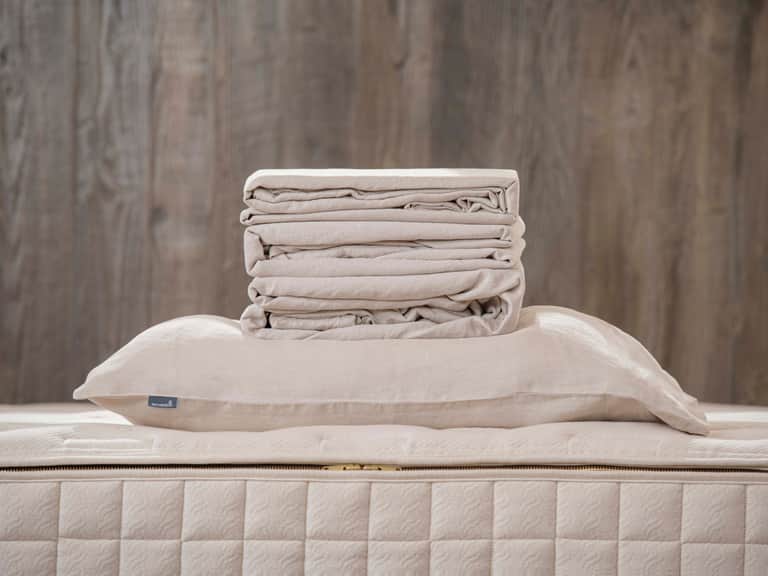
The Naturepedic organic linen sheet set includes one flat sheet, one fitted sheet, and two pillowcases. It does not include a duvet cover or comforter. That distinction sounds obvious, but bedding descriptions often group coordinated pieces together, so a quick inventory can help you compare sets accurately.
If you are building a complete linen bed, the matching Naturepedic Organic Linen Duvet Cover Sets are a separate item. The listed duvet set includes a duvet cover and two pillow shams, with corner ties intended to help keep an insert in place. Check its dimensions against your duvet before purchasing; a sheet set and a duvet set are different components with different sizing needs.
Color can be part of the decision, too. The sheets are listed in Arctic Snow, Beige, Harbor Island, and Forest Canopy. Neutral and nature-inspired shades can be easy to coordinate, but color names alone do not reliably convey their appearance. Screen settings and room lighting can shift how a shade looks, so consult current product details and any available fabric or color information before settling on a choice.
It is also helpful to distinguish between claims about material and practical evidence. The product listing describes the linen as GOTS-certified organic and says the flax is grown in France, while the sheets are made in India in a GOTS-certified organic facility. These are specific sourcing and certification details. If certification is central to your decision, review the current documentation and the scope of the certification rather than relying on a general sustainability impression.
Care that suits an everyday routine
Even a durable fabric needs sensible laundering. The care instructions for Naturepedic sheets specify machine washing warm, tumble drying on low, warm ironing if desired, and no bleach. Following the label is a straightforward way to reduce unnecessary stress on the fibers and preserve the appearance of the bedding over time.
For a first wash, avoid overloading the machine. Sheets need room to move through water and rinse properly. Use an appropriate amount of detergent: too much can leave residue, while overly aggressive washing products may be unnecessary for routine cleaning. Separate pieces when needed to reduce tangling, and take care not to wash linen with items likely to snag it, such as garments with exposed hooks or rough fasteners.
Low-temperature tumble drying is the listed instruction. Remove sheets promptly when dry if you want to limit creasing, or smooth them onto the bed for a softer, more relaxed finish. If you prefer a neater look, the care information allows warm ironing. Linen naturally wrinkles, though, so a completely pressed appearance may take more effort than with some other fabrics.
Skip bleach, as directed, and avoid assuming that fabric softener is necessary to make linen pleasant. The product information says the sheets soften with washing. A simple, consistent care routine is usually easier on both the fabric and the person doing laundry. If a stain occurs, treat it promptly using a method appropriate for the stain and color, and check the care guidance before trying a strong product.
How often you wash sheets is a personal household choice shaped by climate, routine, and individual needs. Whatever schedule you follow, make sure the fabric is fully dry before storing it. Damp storage can create unpleasant odors and may encourage mildew in textiles. A dry, breathable storage space helps keep clean sheets ready for their next turn on the bed.
A thoughtful look at durability and value
Premium sheets are an investment, so price should be considered alongside construction, care, and expected use. Naturepedic’s product listing describes the linen as balancing strength and softness and says it is designed to soften over time. Those qualities may appeal to someone seeking a long-term bedding staple, but durability depends on everyday handling as well as the fabric itself.
Useful questions include whether the fitted sheet remains secure, whether seams and elastic hold up, and whether the fabric continues to feel comfortable after washing. Strong laundry habits can support longevity: avoid overcrowding, follow the temperature instructions, and do not use bleach. Rotate between sheet sets if possible, giving each set time out of regular use rather than repeatedly washing and wearing just one.
Think about value in terms of cost per use, not just the initial price. If you enjoy the texture, use the set regularly, and care for it appropriately, a well-made set may earn its place in the rotation. But the most expensive option is not automatically the best one for every sleeper. A more affordable fabric that suits your preferences perfectly may be a better everyday choice.
Likewise, organic sourcing is a meaningful consideration for shoppers who prioritize material standards, but it should be evaluated as one part of the product rather than a blanket promise about every environmental impact. Cultivation, processing, dyeing, transport, product life, and eventual disposal all contribute to a textile’s broader footprint. Clear sourcing and certification details can inform the decision while leaving room for realistic expectations.
Who may appreciate linen sheets?
Naturepedic’s linen sheets may be worth considering if you like natural fiber bedding, want a more textured hand than smooth cotton, and appreciate a fabric that can soften with use. The set’s listed colors, standard sheet components, and 15-inch fitted pocket also give shoppers concrete criteria to compare against their existing bed.
They may be less suitable if you strongly prefer a sleek, wrinkle-resistant finish, want a silky surface from the first night, or do not want to follow care instructions. Linen’s character is part of the experience: its texture, weight, and relaxed creasing are not flaws to be corrected, but they are not universally appealing either.
People with sensitive skin should rely on their own experience and, where available, a retailer’s return or exchange terms. Product descriptions may discuss a looser weave or organic certification, but no sheet can be promised to suit every individual or prevent a particular reaction. If you have a known textile sensitivity, check fiber and finishing information carefully before making a decision.
A simple pre-purchase checklist
Before choosing a set, take a moment to run through the questions that matter most in daily use. A little measuring and label-reading can make the decision feel less like guesswork.
- Measure the mattress: Include the height of any topper and protector, then compare the total with the listed 15-inch fitted-sheet pocket.
- Check your bed size: The sheets are listed in Queen, King, and California King. Confirm the option matches your mattress.
- Confirm the set contents: Expect a flat sheet, fitted sheet, and two pillowcases; a duvet cover is a separate purchase.
- Consider the hand: Linen is textured and relaxed, not necessarily sleek or wrinkle-free. Decide whether that feel sounds appealing.
- Review care requirements: The listed instructions call for warm machine washing, low tumble drying, optional warm ironing, and no bleach.
- Think through color and coordination: Compare the available shades with your room and other bedding, keeping in mind that screens can affect color appearance.
- Look at the full value: Weigh material, fit, included pieces, care, and expected frequency of use together.
The everyday verdict
Evaluating Naturepedic sheets is less about chasing a superlative and more about matching specifications to the realities of your bed. The organic flax linen has a substantial, textured character, is described as breathable and moisture-managing, and is intended to soften through washing. The 185 gsm fabric weight provides useful context, while the 15-inch fitted pocket and included components help clarify practical fit.
For a confident choice, measure your mattress, consider how linen feels compared with the sheets you already enjoy, and make sure the care routine is one you can live with. Read sourcing and certification details carefully if they are important to you, and remember that fabric performance is personal: no material can promise a perfect night for everyone.
When those details line up with your preferences, linen can become a comfortable, enduring part of the bedroom rather than a special-occasion textile. The best sheet set is ultimately the one that fits your mattress, feels right against your skin, and makes the everyday ritual of making the bed a little more satisfying.